

↑
To : Canto – general comment
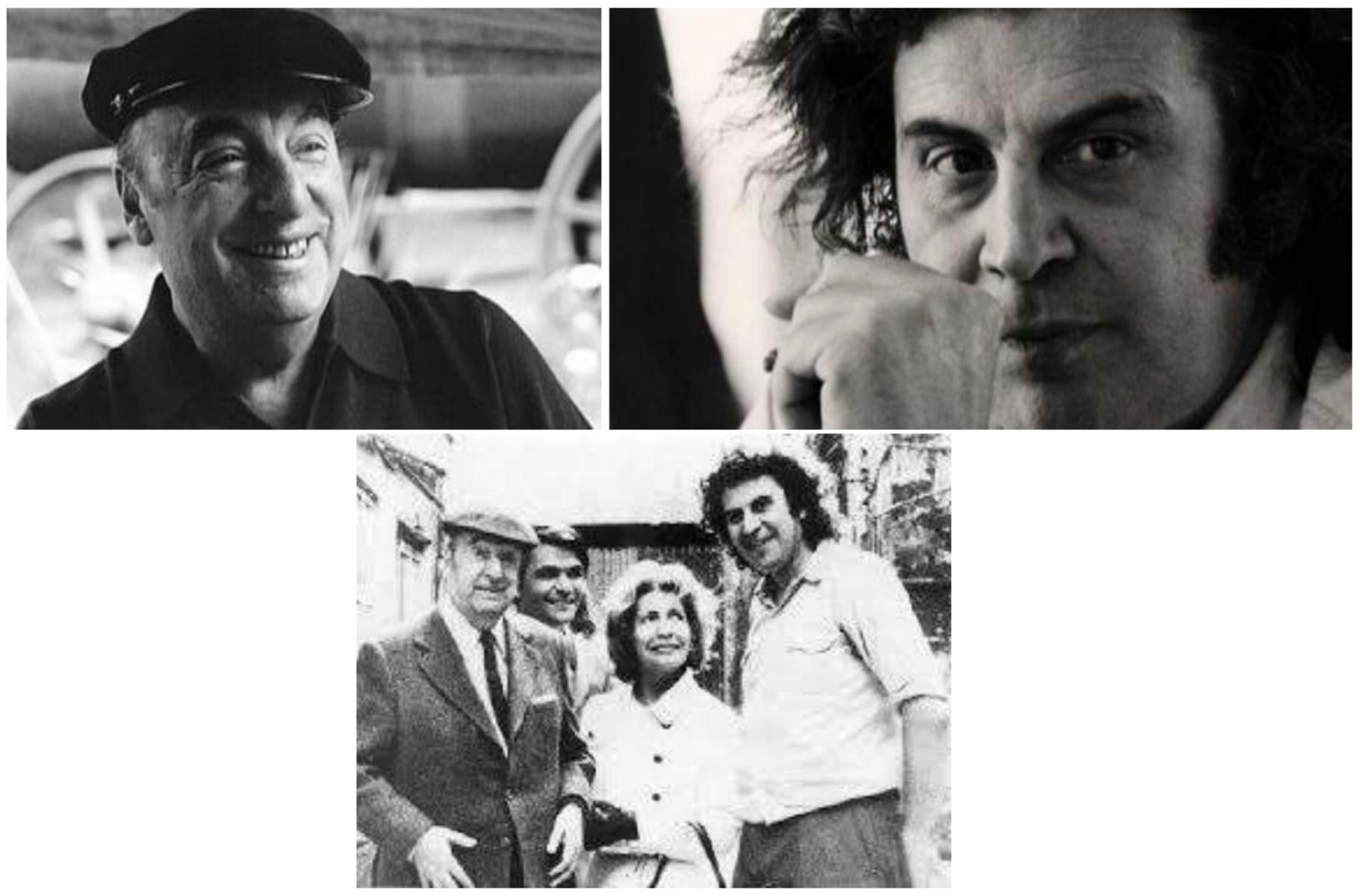
Le Canto General est un poignant « cri de l’humanité » mettant en scène les écrits du poète chilien Pablo Neruda sur une musique du compositeur grec Mikis Theodorakis.
Pablo Neruda évoque en des images saisissantes l’histoire des peuples latino-américains luttant contre les oppresseurs venus exploiter leur terre et les hommes qui la peuplent.
Cette impressionnante saga poétique, élevant jusqu’au ciel, par le symbole de l’arbre, les larmes et les victoires de l’humanité, a été mise en musique par Mikis Theodorakis, au nom des mêmes idéaux pour lesquels il a été emprisonné, déporté, torturé et exilé.
« Depuis cette époque et par intermittence, la politique s’est mêlée à la poésie et à ma vie. Il n’était pas possible, dans mes poèmes, de fermer la porte à la rue, de même qu’il n’était pas possible, dans mon cœur de jeune poète, de fermer la porte à l’amour, à la vie, à la joie ou à la tristesse. »
Pablo Neruda
« Mes vers ne veulent pas se soumettre à la vision déçue d’un monde en décrépitude, mais ils ne se soumettent pas non plus à une vague et douloureuse adoration de quelque chose qui n’a plus de signification vivante. »
Pablo Neruda
Le peuple du Chili m’a fortement impressionné. De tous les peuples que je connais, le peuple chilien est le plus proche du peuple grec, par son caractère et par son tempérament.
Nous nous ressemblons avec toutes nos faiblesses, mais aussi nos forces qui sont l’enthousiasme, la foi, le pathétique, la fraternité. J’ai tout de suite reconnu dans le Chili ma seconde patrie.
« Canto General » est pour moi comme un évangile de notre temps.
Neruda y révèle son âme de combattant. Son œuvre saisit les événements historiques de son pays de façon immédiate. Elle est sensée aider les hommes à vaincre des temps de crise et à imposer le droit. Neruda, délibérément se met au service de la révolution des peuples pour la liberté, l’indépendance et la démocratie.
Mikis Theodorakis
Quand Pablo Neruda a obtenu le Prix Nobel en 1971, son Canto General a été défini comme le poème américain qui donne vie aux destinées et aux rêves d’un continent et dans lequel un continent prend conscience de sa valeur.
Pablo Neruda, « mécanicien de l’âme », évoque en des images saisissantes la naissance de ce continent et l’histoire des peuples qui y ont vécu, qui y vivent, y souffrent et y luttent contre les oppresseurs venus avec les armes pour exploiter les hommes et la richesse d’une nature exubérante.
C’est ce qui confère à l’œuvre son caractère universel.
Cette poésie « tellurique » parle en des métaphores puissantes, en des déferlements d’images et de rythmes, de l’univers, au centre duquel il y a l’homme, l’homme comme élément de la nature, qui en souffre et qui en tire en même temps sa force.
Les rapports entre l’homme et la nature deviennent symbole et modèle pour les relations entre les êtres.
L’ensemble des poèmes constitue le récit épique du peuple sud‐américain depuis la période précolombienne, jusqu’à l’indépendance en passant par la domination espagnole.
On y décrit l’histoire des hommes, des tribus d’indigènes, des petites gens, leurs combats, leurs espoirs, leurs révoltes.
Englobant à la fois l’histoire d’un homme et celle de tout un continent, le Canto General est en quelque sorte une saga des peuples opprimés par la dictature tels qu’ont pu l’être la Grèce, le Chili ou l’Espagne.
Dans cette exaltation du processus de libération des hommes, Neruda a su allier violence et humour, tendresse et force d’imprécation.
Rien d’étonnant non plus que sa mise en musique de poèmes du Canto General ne reflète le même élan vital, la même intensité expressive, la même vérité que la poésie.
Cette vérité est celle de l’engagement, et tout en évoquant les caractéristiques de la musique latino‐américaine et l’esprit de la « grécité » (notamment par l’utilisation du bouzouki), la musique n’est pas moins universelle que le poème fleuve qui l’inspire, alors que le choix des poèmes fait sur le conseil d’Allende et de Neruda, est tel qu’ils constituent en fait la synthèse du « Canto General », dans laquelle s’alternent les élans épiques et les chants intimes.
Le compositeur caractérise cette alternance, en différenciant l’ampleur de l’instrumentation et les moyens vocaux mis en œuvre. Ils vont du chœur a cappella à l’explosion hymnique par toutes les voix, solistes et chorales, et par l’éclat d’un orchestre, inaccoutumé, certes, mais si proche de l’esprit de la musique latino-américaine et tellement expressif.
Y domine l’élément rythmique, le poids mélodique étant porté sur les voix.
Pour ce qui est du choix des poèmes en détail :
• Il y a, en premier lieu, les vers merveilleux qui évoquent la genèse du continent, la naissance de la végétation, des oiseaux et de certaines bêtes :
Vegetaciones, Vienen los pajaros, Algunas bestias.
• Il y a ensuite les poèmes qui témoignent de l’oppression et de l’exploitation du continent sud‐américain :
La United Fruit Co., et de l’amour de Neruda pour sa terre opprimée : Amor America, …
• Il y a ceux qui prennent le contrepied et qui chantent les luttes héroïques et folles pour la libération de cette terre meurtrie :
Los Libertadores, America Insurrecta, …
• Et ceux qui évoquent les grandes figures de ces combats généreux :
Lautaro, Sandino, Emiliano Zapata.
• Il y a les mots tout simples et intimes par lesquels Neruda se découvre et s’implique lui‐même dans ce monde en gestation et en évolution et par lesquels il exprime ses convictions politiques :
Voy a vivir, A mi partido, …
• Et, enfin, il y a, au cœur même de la partition,
le Neruda Requiem
que Mikis Theodorakis a écrit pour son ami et compagnon de lutte.
Canto – general comment
⇑
Canto General is a poignant cry of humanity’ featuring the writings of Chilean poet Pablo Neruda set to music by Greek composer Mikis Theodorakis.
Pablo Neruda evokes in striking images the history of Latin American peoples fighting against oppressors who came to exploit their land and the people who inhabit it.
This impressive poetic saga, which elevates the tears and victories of humanity to the heavens through the symbol of the tree, was set to music by Mikis Theodorakis in the name of the same ideals for which he was imprisoned, deported, tortured and exiled.
“Since that time, politics has intermittently intertwined with poetry and my life. It was impossible in my poems to close the door on the street, just as it was impossible in my heart as a young poet to close the door on love, life, joy or sadness.”
Pablo Neruda
« My verses refuse to submit to the disillusioned vision of a world in decay, but neither do they submit to a vague and painful adoration of something that no longer has any living meaning. »
Pablo Neruda
“The people of Chile made a strong impression on me.
Of all the peoples I know, the Chilean people are the closest to the Greek people in character and temperament. We are alike in all our weaknesses, but also in our strengths, which are enthusiasm, faith, pathos and brotherhood. I immediately recognised Chile as my second homeland.
For me, Canto General is like a gospel of our time.
In it, Neruda reveals his fighting spirit. His work captures the historical events of his country in a direct way. It is intended to help people overcome times of crisis and impose justice. Neruda deliberately puts himself at the service of the peoples’ revolution for freedom, independence and democracy.”
Mikis Theodorakis
When Pablo Neruda won the Nobel Prize in 1971,
his Canto General was described as the American poem that brings to life the destinies and dreams of a continent and in which a continent becomes aware of its value.
Pablo Neruda, the “mechanic of the soul”, evokes in striking images the birth of this continent and the history of the peoples who have lived there, who live there, who suffer there and who struggle against the oppressors who came with weapons to exploit the people and the wealth of an exuberant nature.
This is what gives the work its universal character. This “telluric” poetry speaks in powerful metaphors, in a flood of images and rhythms, of the universe, at the centre of which is man, man as an element of nature, who suffers from it and at the same time draws his strength from it. The relationship between man and nature becomes a symbol and model for relationships between human beings.
The collection of poems constitutes an epic narrative of the South American people from the pre-Columbian period through Spanish domination to independence. It describes the history of men, indigenous tribes, ordinary people, their struggles, their hopes and their revolts.
Encompassing both the history of one man and that of an entire continent, Canto General is, in a way, a saga of peoples oppressed by dictatorship, such as Greece, Chile and Spain.
In this exaltation of the process of human liberation, Neruda skilfully combined violence and humour, tenderness and the force of imprecation.
It is also unsurprising that his musical setting of poems from Canto General reflects the same vital energy, the same expressive intensity, and the same truth as the poetry. This truth is that of commitment, and while evoking the characteristics of Latin American music and the spirit of ‘Greekness’ (not only through the use of the bouzouki), the music is no less universal than the epic poem that inspires it, while the choice of poems, made on the advice of Allende and Neruda, is such that they constitute a synthesis of Canto General, in which epic bursts alternate with intimate songs.
The composer characterises this alternation by differentiating the scale of the instrumentation and the vocal means employed. They range from a cappella choir to an explosive hymn sung by all voices, soloists and choir, accompanied by the brilliance of an orchestra, unusual, certainly, but so close to the spirit of Latin American music and so expressive; the rhythmic element dominates, with the melodic weight carried by the voices.
As for the choice of poems in detail:
• First, there are the wonderful verses that evoke the genesis of the continent, the birth of vegetation, birds and certain animals:
Vegetaciones, Vienen los pajaros, Algunas bestias.
• Then there are the poems that bear witness to the oppression and exploitation of the South American continent:
La United Fruit Co., and Neruda’s love for his oppressed land: Amor America, …
• There are those that take the opposite view and sing of the heroic and crazy struggles for the liberation of this wounded land:
Los Libertadores, América Insurrecta, …
• And those that evoke the great figures of these generous struggles:
Lautaro, Sandino, Emiliano Zapata.
• There are the simple, intimate words through which Neruda reveals himself and involves himself in this world in gestation and evolution, and through which he expresses his political convictions:
Voy a vivir, A mi partido, …
• And finally, at the very heart of the score, there is
the Neruda Requiem
that Mikis Theodorakis wrote for his friend and comrade in arms.
⇑